Information-Theoretic Capacity of Large Language Models: A Relational Perspective
4 September 2025
Originally published on Medium, September 2025.
How transformer architectures achieve extraordinary knowledge density through relational encoding

Large language models present a fundamental puzzle in information theory. A 7-billion parameter transformer model, occupying approximately 14 GB in half-precision format, demonstrates knowledge across domains that would traditionally require orders of magnitude more storage. This apparent paradox reveals something profound about how these architectures encode and compress information.
The Storage-Performance Paradox
Consider the empirical evidence: modern transformer models exhibit competency across hundreds of distinct tasks, demonstrate factual knowledge spanning multiple domains, and can perform complex reasoning operations — all within remarkably constrained storage footprints.
If we attempted to replicate this knowledge using conventional data structures, we would need:
- Millions of discrete facts and assertions
- Complex relationship mappings between concepts
- Contextual rules governing when information applies
- Syntactic and semantic transformation rules
- Domain-specific reasoning patterns
A naive implementation would require several terabytes of storage, yet these models achieve equivalent functionality in gigabytes. The compression ratio suggests we're observing a fundamentally different approach to information encoding.
Beyond Shannon Entropy: Relational Information Theory
Traditional information-theoretic analysis focuses on the entropy of weight distributions:
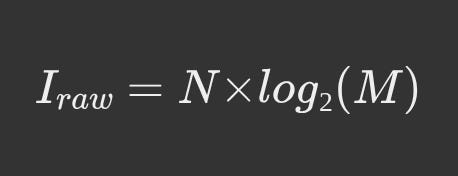
Where N represents parameter count and M the discrete states per parameter. For a 7B model in fp16, this yields approximately 1.12 × 10¹¹ bits of theoretical capacity.
However, this framework mischaracterizes how transformer architectures actually encode information. These models don't store discrete facts — they encode a complex graph of relationships where:
- Nodes represent elements in vocabulary space (~50K tokens)
- Edges represent learned associations with varying strengths
- Multiple parallel graphs exist (one per attention head across layers)
With typical architectures containing 32 layers and 32 attention heads, we have 1,024 distinct relational projections, each capturing different aspects of semantic, syntactic, or pragmatic relationships.
Three Mechanisms of Compression
1. Compositional Representation
Instead of storing individual sequences, models learn probability distributions over sequence space. The information content becomes:

This enables exponential scaling: learning compositional rules allows generation of far more valid outputs than could be explicitly stored. A single learned pattern like "[ENTITY] is located in [LOCATION]" can generate thousands of factual statements using minimal parameter overhead.
2. Feature Superposition
Recent interpretability research reveals that models encode more features than available dimensions through superposition. In a d-dimensional space encoding k features where k >> d:

Empirical evidence suggests k/d ratios between 10:1 and 100:1, multiplicatively increasing information density. This is achieved through interference patterns that allow multiple features to coexist in the same representational space without destructive overlap.
3. Hierarchical Abstraction
Transformer layers build increasingly abstract representations:
- Early layers: Character patterns, subword relationships
- Middle layers: Semantic concepts, syntactic structures
- Late layers: Complex reasoning, contextual integration
Each abstraction level compresses information from previous levels while enabling more sophisticated operations. This hierarchical encoding mirrors principles from data compression algorithms but operates on semantic rather than syntactic patterns.
Quantitative Analysis
Conservative Estimate: Explicit Relationships
Considering only directly representable relationships:
- Binary relations between vocabulary items: C(50,000, 2) ≈ 1.25 × 10⁹
- Distributed across 1,024 attention mechanisms
- Effective precision ~8 bits per relationship

Moderate Estimate: Compositional Structures
Including compositional generation capabilities:
- Distinguishable n-gram patterns (n ≤ 5): ~10¹⁵
- Contextual variations per pattern: ~10³
- Syntactic transformations: ~10²

Comprehensive Estimate: Full Generative Capacity
Considering the complete space of coherent outputs:
- Perplexity-constrained sequence space: ~10²⁰ distinguishable sequences
- Pragmatic appropriateness filtering: ~10² reduction factor
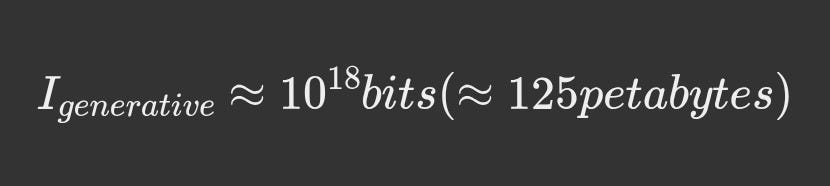
These estimates suggest compression ratios of 10⁵:1 to 10⁸:1 compared to raw parameter storage.
Empirical Validation
Cross-Domain Generalization
Models trained solely on next-token prediction exhibit emergent capabilities across:
- Translation between 100+ language pairs
- Mathematical reasoning and symbolic manipulation
- Code generation across programming paradigms
- Creative synthesis within multiple genres
This generalization suggests the models have learned abstract patterns that transfer across domains — exactly what we'd expect from efficient compression schemes that capture underlying structural regularities.
Knowledge Retrieval Density
Performance on factual benchmarks indicates storage of:
- 10⁶-10⁷ discrete facts
- 10⁸-10⁹ relational assertions
- 10¹⁰-10¹¹ contingent implications
This knowledge density exceeds conventional storage by factors of 10⁴-10⁶ within the same space constraints.
Compression Mechanisms
Distributed Representation
Information emerges from parameter interactions rather than individual values. Each fact results from the collective behavior of thousands to millions of parameters, enabling massive redundancy reduction while maintaining robustness.
Amortized Learning
The model amortizes pattern learning across similar structures. Syntactic templates like [SUBJECT][VERB][OBJECT] are learned once and applied to millions of instantiations, achieving compression ratios exceeding 10⁶:1 for structural knowledge alone.
Implicit Regularization
Training dynamics impose minimum description length constraints, naturally compressing representations by exploiting statistical regularities in the data distribution. This parallels optimal coding techniques but operates on semantic rather than bit-level patterns.
Theoretical Implications
Redefining Model Capacity
These findings suggest neural network capacity should be measured not by parameter count alone, but by effective information encoding capability:

This functional relationship represents a significant open research area with implications for architecture design and scaling strategies.
Scaling Law Interpretation
Observed scaling laws become more interpretable through this lens. Parameter increases don't merely add storage capacity — they multiplicatively enhance the model's ability to encode complex relational structures. This explains why scaling often produces qualitatively different capabilities rather than just quantitative improvements.
Fundamental Limits
If these compression ratios approach theoretical limits for human-like knowledge representation, they suggest:
- Human knowledge exhibits high compressibility due to underlying structural regularities
- Transformer architectures may have discovered near-optimal encoding schemes for natural language patterns
- Future improvements may require architectural innovations rather than simple scaling
Research Directions
Several critical questions emerge:
Architecture Optimization: Can we design architectures that achieve even better compression ratios by explicitly optimizing for information density?
Measurement Frameworks: How do we accurately quantify the effective information content of these models beyond behavioral assessments?
Compression Principles: What general principles govern efficient encoding of structured knowledge that could be applied to other domains?
Biological Parallels: Do these mechanisms mirror information processing strategies in biological neural networks?
Conclusion
Large language models achieve extraordinary compression ratios through relational encoding mechanisms that fundamentally differ from traditional storage approaches. By learning to represent patterns rather than instances, exploiting superposition in high-dimensional spaces, and building hierarchical abstractions, these models compress human-like knowledge at ratios approaching theoretical limits.
This represents more than an engineering achievement — it reveals something fundamental about the structure of human knowledge itself. The fact that such compression is possible suggests that natural language, reasoning patterns, and factual knowledge exhibit deep regularities that can be captured by relatively simple mathematical operations.
Understanding these compression mechanisms will be crucial for developing more efficient architectures, interpreting model behavior, and potentially uncovering general principles of intelligent information processing. We may be observing not just impressive engineering, but glimpses of fundamental laws governing how structured knowledge can be efficiently encoded in distributed systems.
This analysis is based on empirical observations and theoretical modeling. The actual mechanisms by which transformer architectures achieve these compression ratios remain active areas of research in mechanistic interpretability and information theory.
Technical Notes
Research Focus: Information theory, neural network interpretability, knowledge representation
Keywords: information compression, transformer architectures, relational encoding, feature superposition, compositional representation